
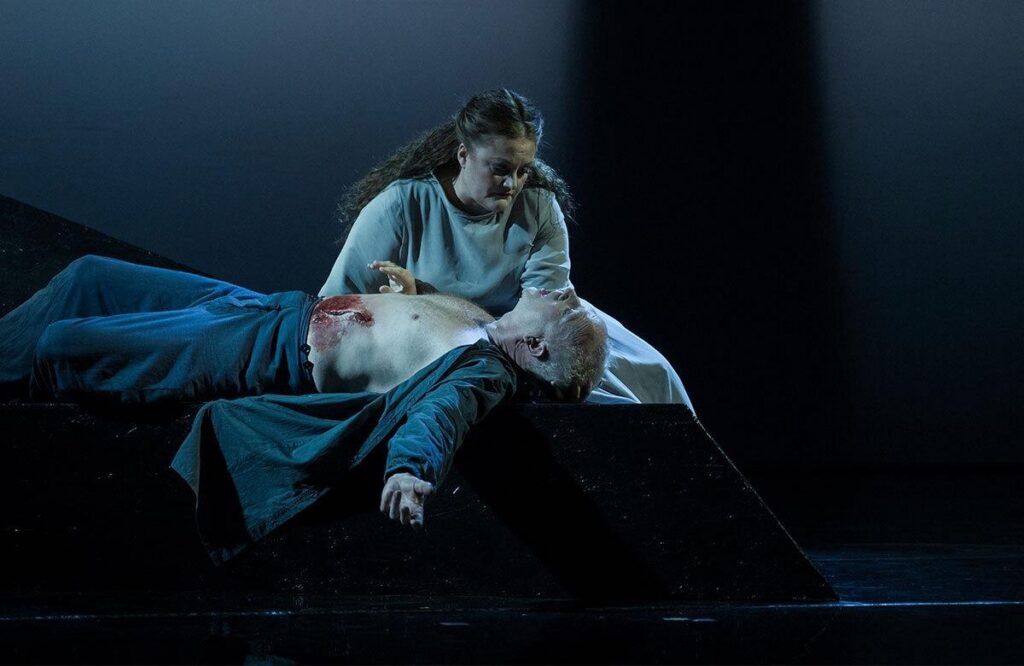
Courtesy of The Stage: Catharine Woodward and Peter Wedd in Tristan und Isolde at Longborough Festival Theatre, Moreton-in-Marsh, Gloucestershire. Photo: Matthew Williams Ellis
This summer goes some way to proving my point. As Count Bucketface locks bin liners with Nigel Farage in the Clacton end of the pier by-election show, and a King of the North swoops south to knife yet another hapless Downing Street incumbent (think Verdi’s Macbeth and the slaughter of King Duncan), Longborough Festival Opera’s revival of Richard Wagner’s Tristan und Isolde proved a refreshing encounter with emotional reality.
Ignorant critics claim opera is pure fantasy, ungrounded in the real world. I don’t buy that.
Coincidentally, Macbeth preceded Tristan at Longborough. The opera house in the Palladian Cotswold chicken shed is politically au courant.
Longborough, a.k.a. the British Bayreuth, has revived it’s epic 2015 production of Wagner’s doomed love story, cementing its reputation as the go-to country house festival for Wagner fans.
The first to mount a full Ring Cycle in 2024. The first in Britain to stage Wahnfried in 2025. Avner Dorman’s opera narrating the shaping of the Wagner cult over forty years following the composer’s death. Step up Cosima Wagner and faux historian Houston Stewart Chamberlain, a dangerous 19th century Count Bucketface. Hitler featured.
The 2027 season offers Die Meistersinger von Nürnberg. Wagner in the genes. But not to the exclusion of other exciting works. This season features Handel’s Orlando, Verdi’s Macbeth and Humperdinck’s Hansel and Gretel.
Tristan changed the world of 19th and arguably 20th – century opera. The sung through score, unresolved psychological tension with the legendary Tristan chord remaining unresolved until the dying moments, the use of leitmotifs encapsulating themes and characters. And for me, the big enchilada, the use of orchestra as character, enhancing the subconscious emotions driving the plot.
Oceans of ink have been spilt in describing the Tristan effect. I shall forbear spilling more. And provide this link to an interview with Anthony Negus, Longborough’s Music Director and Conductor on the night, during a visit to Melbourne eight years ago. Because Anthony knows best!
I have seen two Tristans already this year. The Metropolitan Opera’s new production directed by American Yuval Sharon and Longborough’s directed by German born Carmen Jakobi. Negus is married to Jakobi.
Sharon’s production was complex. Replete with objects as metaphor. The hourglass counting out time, which during the performance I saw exploded dramatically on Isolde’s (Lise Davidsen) first touch. Making time stand still completely. ‘Brief pause’ for the backstage Dysons to scoop up the mess. Doppelganger Tristans and Isoldes for ……. er, not sure what. And a baby delivered randomly at the end by Brangäne, Isolde’s devoted handmaid. A supernumerary too far!
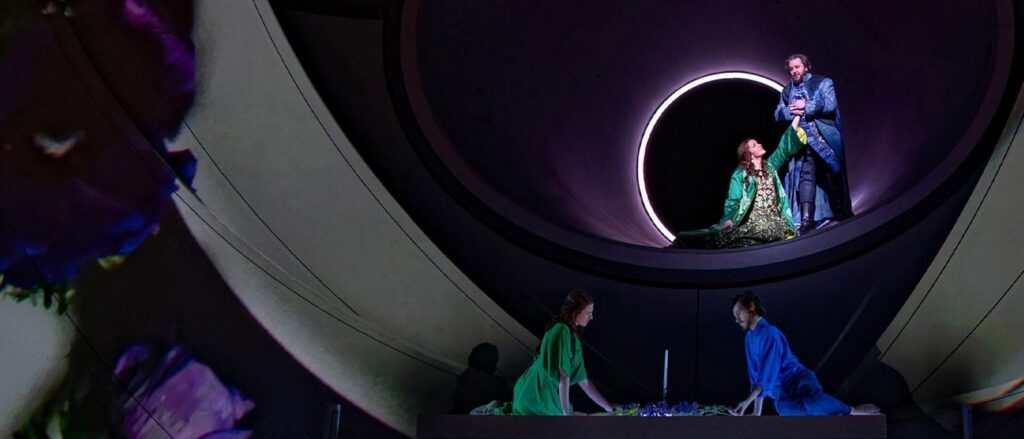
Courtesy Metropolitan Opera – in full doppelganger mode!
It was slick, but distracting.
A clever, original director like Sharon can dream up a complex production. But it takes a genius to deliver simplicity and let nothing get in the way of Wagner’s words and music. Jakobi is that genius. The spare set, the implied billowing sails. All trivia stripped.
Four hours sped by in a trice, as the audience was gripped from the start and never allowed to relax. In part, this is down to the intimacy of the house, 500 seats.
But the clincher was the Longborough production team’s attention to physical blocking, character interpretation and overall dramatic vision.
Shout outs for Lucy Cullingford, Movement Director and Intimacy Coordinator (and there was much intimacy); Sam Lyon-Behan, Fight Director and Guido Martin-Brandis, Assistant Director.
There are passages when the mood of the characters turns on a dime, when a disapproving glance from Brangäne tells you as much as Isolde’s sung libretto. For instance, even in full flight ecstasy Isolde can be a dreadful scold.
When in Scene II of the final act she arrives triumphantly and thinks Tristan dead, she interrupts her mourning to complain that she had come to marry him, but blurts out – ‘Too late, Spiteful man.’ Unless that line is delivered in tones of pitch perfect frustration, its significance is overstated. Meaning forfeit.
The libretto is littered with similar contradictions. They were delivered by the characters faultlessly.
Attention to important detail, such as the contrast between night and day, with night being the only time when love can be fulfilled, foreshadows the closing Liebestod. When Tristan and Isolde are bound together forever in death.
There was a growing sense of the inevitable, the direction of the plot moving inexorably towards tragedy. Unresolved until the end – like that Tristan chord.
For readers unfamiliar with the plot, there is a helpful synopsis to be found here.
Longborough delivered a stellar cast. English soprano, Catherine Woodward, was a restrained and thoughtful Isolde. In Act I when Tristan refuses to see her as the ship heads towards Cornwall ‘I’m needed on deck, dear’ she resisted the temptation to dissolve into hissy fits.
With a full and carrying voice Woodward is at the zenith of her career. This Musical America profile will tell you more.
Peter Wedd, tenor, understood how to deliver presence, even while standing aloof backstage. And with passionate delivery he was a convincing Tristan in every way.
Brangäne was experienced Australian mezzo soprano Catherine Carby. Often Brangäne is wrongly portrayed as a put upon gofer. Carby was every inch the handmaid. It’s an important role. Not least because she delivers the love potion! It’s all Brangäne’s fault.
The orchestra under the baton of Maestro Negus sparkled. And shimmered when the closing notes of the Liebestod faded to nothing. As is customary, the savvy Longborough audience maintained silence for fully five seconds after the stage went dark, to let the implication of what they had just heard and seen sink in.
I drove home to London in solitary silence. I wanted nothing to intrude. I had drunk the Longborough potion.