
Mason Bates and Gene Scheer’s take on Michael Chabon’s 2001 Pulitzer Prize winning novel brings comic book superhero action to life on the Met stage
Credit: Metropolitan Opera
The amazing – and slightly bonkers – adventure of composer Mason Bates and librettist Gene Scheer, condensing Michael Chabon’s 2001 Pulitzer prizewinning 700-page doorstopper of an extravaganza novel, The Amazing Adventures of Kavalier and Clay, has delivered a compelling new drama for the opera stage.
No less a stage than New York’s Metropolitan Opera, where the 2025/2026 season kicked off to yet another Peter Gelb controversial opener. The Met Director knows how to raise the blood pressure of the Met’s trad subscribers.
Last fall his Lincoln Center audience found itself ‘Grounded’, by composer Jeanine Tesori and librettist George Brant’s epic story about the heart-wrenching mental challenges of drone warfare waged from afar. Très à la mode.
In the eyes of my fellow Met Opera Club members, I’m a Philistine. I loved Grounded. So good I saw it twice! Especially moved by the grit of soprano, Emily d’Angelo, nailing the role of an F16 pilot, turned drone controller.
Kav and Clay (forgive the abbreviation) is similarly laden with topical tropes – antisemitism, immigration, sexual intolerance, the struggle with Jewish identity, disregard for the rule of law. Challenging enough in the late 1930s. Still testing us today.
Pre performance, we were treated to a dreary, ill-advised and badly articulated ‘welcome’ speech from Gelb. After a rousing rendering of The Star-Spangled Banner. It was noticeable that a sizable chunk of the audience remained seated during the national anthem. Presumably an anti-Trump protest.
A word to the wise from this political Brit who grinds his teeth every time the absurd Nigel Farage waves a Union Jack in his face. Don’t give dingbats the satisfaction of appropriating national symbols – or anthems.
Gelb would have been well advised to stick to introducing the treats in store for the upcoming season. Maybe give some explanation of his recent fuzzy-funding arrangement with Saudi Arabia, which flew into a surprised Lincoln Center on 3rd September.
‘It’s a memorandum of understanding! It’s a binding contract! No, it’s Super-Deal.’ A $200m pledge for which the Met will spend five years in the desert. I just hope there is cash up front to staunch the arterial drain of cash from the Met’s rapidly dwindling endowment.
If I were on the Met board, I would be asking searching questions about revenue recognition. And what deal Gelb has struck with the unions to get singers, orchestra and kit on that Saudia A380 in 2027.
Instead, we got a distracting reference to the ‘need to defend our artistic values’, a barely concealed grump at Donald Trump’s risible takeover of Washington’s Kennedy Center. That’ll keep the Met audience’s mind off the real issues, Peter!
Then, to the bafflement of all, a buffa turn from Senator Chuck Schumer, senior senator from New York State and Senate Minority Leader. He harangued a puzzled audience about his 2020 Covid legislation. And the dumping of Jimmy Kimmel – which has since been reversed. No thanks to Schumer. Then he ambled off.
Maybe he’d picked up the wrong libretto. Whatever, he was met with a chorus of cheers and boos. House divided.
On with the show. Kav and Clay is set in three worlds. The production came courtesy of Bartlett Sher, a gifted director who spans Broadway and opera stage alike.
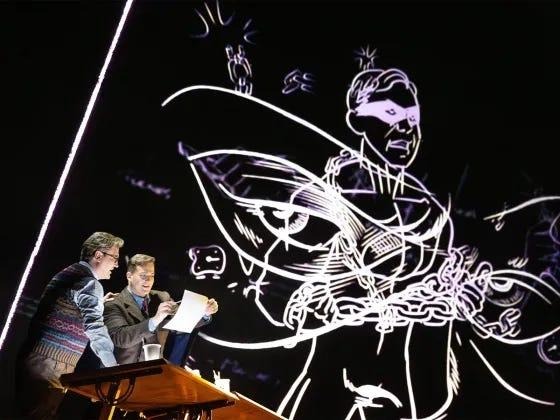
He shaped three very distinct environments. A dark and sinister Prague, an upbeat and pulsing late1930s New York, and the colourful comic book world in which the opera’s fictional hero, The Escapist, biffs Herr Hitler and assorted goons. Then, Comic Book heroes were a reading rage. Now, they get elected.
The set lighting and design, crucial elements of this production, were provided by 59 Studio, New York and London. Their illuminated white-line drawings of trains and a transport ship, The Ark of Miriam, filling the stage like flowing water were wonderfully evocative. As was the sinister set of the Prague station with huddled prisoners awaiting their train to God knows where. Kav and Clay served up a visual feast.
Check out 59 Studio’s 2019 light show on Washington’s National Mall, Appollo 50: Go For The Moon. The full-size Saturn Rocket projected onto The Washington Monument, blasting into space is just one of their wonders. Richard Wagner, that innovator in 19th C opera-tech, must have been spinning in his grave with envy.
Set movements were slick as we moved from world to world, sometimes merging. At first grounded in conventional fixed scenes in Act II, we moved into surreal surroundings. But for that to have meaning, the story must be told.
Act I
It’s the early days of World War II. Before Pearl Harbor and America’s entry into the conflict. Dark threatening Prague. Bullied by the SS, Joe Kavalier escapes, leaving behind his parents and teenage sister, Sarah.
He arrives in Brooklyn to live with cousin Sam and Aunt Esther. He plans to make enough money to bring his family to the United States, to escape German occupation.
Joe is a gifted artist, amateur magician and escape artist. Sam works in a toy and novelty company. He’s a wisecracking writer. They team up to create a comic-book superhero to rival Superman. The Escapist. I didn’t rate the large, illuminated gold key on his chest. Not quite the discrete Superman ‘S’ costume!
Joe and Sam created their super-hero with a super-purpose – to urge Americans to join Europe’s fight against the Nazis. Sam’s boss at a toy and novelty company, Mr. Anapol, takes a chance on them and backs the venture.
The Escapist becomes a hit, spawning a radio show. Today, it would be a podcast. Attending a broadcast, Joe and Sam encounter their separate fates.
Sam meets Tracy Bacon, the actor who plays The Escapist, to whom he is sexually attracted. Joe meets Rosa, a talented artist who works for the Jewish Children’s Fund, which ferries refugee children from Europe to the U.S. on its own ship, The Ark of Miriam.
There follows a hilarious scene, when Joe and Rosa attend a gallery show, a fundraiser for the Jewish Children’s Fund, where Salvador Dalí makes a guest appearance, entertaining the crowd in a surreal diving suit and helmet. After nearly suffocating, the mustachioed artist is rescued by Joe to acclaim from the gallery crowd.
Joe and Rosa, thrown together by the Dali incident, discuss arranging for his sister, Sarah to escape Prague on The Ark of Miriam. They fall in love.
Back in Prague, Joe’s mother is captured by the Germans and sent to a camp. Joe’s father is taken in a raid led by Gestapo Commander Gerhard. Sarah narrowly escapes.
Joe and Rosa’s relationship blossoms, and Rosa confirms Sarah’s passage on The Ark of Miriam. Meanwhile, Sam and Tracy Bacon have fallen for each other. They share a Shabbat dinner with Sam’s mother, toasting the imminent arrival of Sarah’s ship in New York.
They spend a romantic night atop the Empire State Building – shades of King Kong. Their plan is to train west to Hollywood to capitalise on The Escapist brand.
The idyll is ruined when they discover a newspaper headline reporting The Ark of Miriam has been sunk by German torpedoes. No survivors. Sarah is lost. They race to tell Joe, who is performing his magic act at a benefit for the Jewish Children’s Fund. Rosa tells Joe the news. Before a room filled with dinner guests, he has a breakdown.
Act II
Joe loses the plot. He hides out in a warehouse and imagines a surreal confrontation with nemesis, Gerhard. Rosa, distraught, hasn’t heard anything from Joe for weeks and can’t find him anywhere.
Acting on a clue, she goes to the warehouse and finds a makeshift studio Joe has set up but has trashed, plus evidence he has enlisted and shipped out.
Sam, meanwhile, is attending a going-away party for Tracy, who has joined the military. The party turns out to be an exclusively gay affair, and when it is raided by the FBI, Sam hides while the others are arrested.
A lingering FBI agent discovers Sam and sexually assaults him. His silence is the price of liberty. Rosa finds a broken Sam, who can only say he is finished: He’s convinced he will be alone for the rest of his life.
Rosa is suffering her own crisis. Not only has Joe disappeared without a farewell, but she’s pregnant. Sam offers to marry her and raise the child as his own. Rosa agrees, and they begin a new life together, based on the compromises forced on them by circumstance. A read across to the devastating choices forced on their persecuted European confrères.
Rosa fills in for Joe, drawing The Escapist – and adds a character of her own. Luna Moth, inspired by a story Joe made up for Rosa. Reinforces the success of the comic strip.
Joe turns up on a European battlefield, where he finds Tracy. Tracy shows Joe a letter from Sam telling Tracy to stop writing to him. His new circumstances with Rosa forbid it.
Tracy learns Joe has never opened any of the hundreds of letters Rosa has sent him. Doesn’t know he and Rosa have had a child.
Tracy is killed, and Joe is devastated by yet another loss. He starts opening and reading Rosa’s letters. One letter contains Rosa’s drawing of Luna Moth. And at this point we know we are really in a world of symbolism.
Luna Moth appears to Joe – a shimmering suspended dancer – then guides him out of the battlefield. Miraculously (but that’s what Super-Moths do! Ed.) she leads him to the house on Long Island where Rosa and Sam now live. Outside the door, sister Sarah’s ghost appears and gives Joe the final push. Get on with it. Re-enter your life!
She leads Joe to meet his young daughter, also named Sarah, and to reunite with Rosa and Sam.
Sam, in an act of complete selflessness, boards a train headed for California and picks up his pen to begin writing The Amazing Adventures of Kavalier & Clay.
The music. Bate’s score was filmic, accompanying the action rather than driving it, as would a more conventional operatic score. Apart from some stand-out dramatic moments. One was a soulful rendering of Ani Ma’amin, a song of hope created by a box-car prisoner en route to Auschwitz and sung by the doomed as they filed out to their inevitable deaths.
Bates and Scheer went to great lengths to explain their project to the American Jewish community, as this discussion with Congregation Beit Simchat Torah bears witness. They knew they had to tread sensitively.
But with so many moments of tension and high drama in the action I was left with a feeling that the score was simply not up to the challenge.
In a debut performance, Andrzej Filońcyzyk, a Polish baritone, sang Joe. He was pushed to the limits of his vocal register. Rosa, Sun-Ly Pierce, an American-Chinese mezzo soprano was my stand-out. Her clarity of delivery, on stage empathy and determination ‘to keep buggering on’, as Churchill would have advised, grabbed my attention.
Also excellent was Myles Mykkanen who sang Sam. The Finnish-American tenor had the power to capture the real tragedy of his character. I was left thinking it was a pity he didn’t have a wider musical palette to display his talent.
A full list of the excellent cast can be found here. Maestro Yannick Nézet-Séguin graced the pit.
Kav and Clay has received mixed reviews, none more negative than in The New York Times. Joshua Barone, the paper’s critic du jour, started off with a weird assertion, ‘Opera benefits from simplicity’ and went on to pan the production on the grounds that the book is complex and the precis of Scheer’s libretto cannot do it justice.
Now, I assume Mr Barone goes to the opera quite often, but what ‘simple’ plots is he seeing? To grab a handful from the bran tub, Mozart’s The Marriage of Figaro is fiendishly complex, with subterfuge, mistaken identity and the wrong person jumping out of a window being only the most obvious twists and turns.
Contemporary works like Grounded may be light on Da Ponte comic farce, but they weave subtle moral webs of conflicting loyalty – in love and war – and demand close attention. Then, Mr Barone considers Wagner’s Ring Cycle a tale to be told in minutes. I seem to remember it taking 17 hours spread over four days!
I felt the moral arc of each of the characters, which define the morality tale of Kav and Clay, were deftly delivered in Scheer’s taut libretto. Give me three hours of watching the opera instead of four days reading the book anytime.
On the Saturday before the Sunday opening I was enjoying what I thought was a discreet lunch at Toscana, East 49th Street. Vocally unaware in the quiet restaurant, gabbing about Kav and Clay, I caused a lady with bat-like hearing at an adjacent table to approach. Brandishing a book. Fearing assault, I was relieved to discover it was an original, well thumbed, Chabon edition from 2000.
‘I heard it’s now an opera, for heaven’s sake. Should I go? I just love the book. It must be very long.’ ‘The good news is it’s shorter. I wouldn’t miss it,’ I opined.
Clearly, news had hit the streets and potential opera audiences were flocking. At least to Midtown Italian restaurants. When I reached Lincoln Plaza next evening, for the first time in recent memory I was greeted by folk sporting pleas for spare tickets on cardboard signs. Inside I found a full house.
And when the dust from The Escapist’s passing cloak eventually settled on Lincoln Center Plaza, Peter Gelb announced four additional performances during the house ‘close’ season in February 26. Reaching out to a new audience had worked. Back by popular demand.
Amazing! Almost as amazing as The Adventures of Kavalier and Clay. This year’s Met season is off to a flying start.