
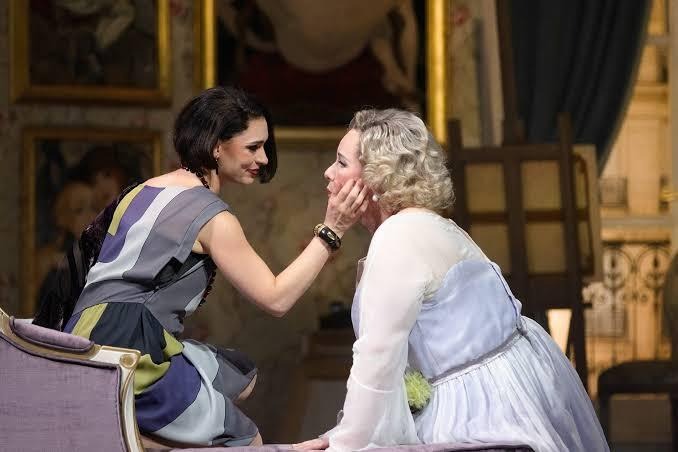
Image: Courtesy of Santa Fe Opera
On the face of it, Tobias Picker’s opera Lili Elbe, premiering at this years Santa Fe Opera Festival should have been a wow! All the stars seemed aligned. Heady cocktail of powerful base spirit plot, a transexual baritone as modifier, sweetener James Robinson directing, garnished with the scenic designs of Allen Moyer and costume designs of Marco Piemontese.
Sad to say, it was a bit of a bust. Picker’s music, praised to the sky in most reviews, was to my ear melodically banal, directionless, over-peppered with fff staccato passages that quickly grated on the nerves. If the score was attuned to the characters, it was lost on me. I longed for an obvious Wagner leitmotif to give the audience a sense of place.
Librettist, Aryeh Lev Stollen, fell short on character development, missing out the prelude to the fascinating story of the transition of Einar Wegener, the 19th/20th century Danish landscape painter, from man to woman, resulting in her death after major surgery to complete the process in 1931. More on that later.
The lead role of Lili was performed by Lucia Lucas – who also sang at the world premiere at Theater St Gallen, Switzerland in 2023. Lucia is a transgender baritone. Was this a spoof? Could this opera really be about Lucia, not Lili?
My amber suspicions of ulterior casting motives turned to red when Lili sang. She had an – how to be generous? – ‘unexceptional’ voice and a clunky stage presence. Set aside the woman/baritone anomaly, which often verged on the ridiculous, for now.
On, for probably mystified readers, to the plot. Synopsis courtesy of Santa Fe Opera:
_
Act I
In the late 1920’s, the actress Anna Larssen of the Royal Danish Theater, having just premiered the role of Orpheus in a new play, could not appear for the last sitting of her portrait, the centerpiece of a new exhibition. Anna makes an unusual suggestion; that the artist, Gerda Wegener, ask Lili Elbe, (at that time known as Gerda’s husband, the artist Einar Wegener), to dress up and pose as Anna. At this sitting Lili is brought to a profound self-discovery, never-before acknowledged. Like Orpheus compelled to look back at Eurydice, Lili can never again turn away from the truth of who she is. Despite the support of Gerda, their friends Eric and Hélène, and Lili’s brother Marius, Lili encounters hostility and rejection from her sister Dagmar and later her own mother. Through the efforts of Marius, she is introduced to Professor Warnekros who agrees to operate on her at the Municipal Women’s Clinic in Dresden.
_
Already Stollen is missing the point. The Einar/Lili/Gerda narrative was a moving and prolonged journey towards the realisation that Einar was female. Not the ‘wham, bam, thank you mam’ moment in the opera when Einar showed a leg, throwing a scarf round his neck, sitting in as artist’s model for the unavoidably detained Anna. ‘Surprise!’
Little care was taken with character development throughout. The Danish Girl, a 2015 biopic film by Tom Hooper starring Eddie Redmayne as Einar/Lilie and Alicia Vikander as Gerda tells the fictionalised story much more sympathetically and develops the characters fully.
_
Act II
After her first surgery, a dramatic encounter with the King of Denmark leads to an extraordinary decree — Lili is legally recognized as a woman, and her marriage to Gerda is annulled.
Despite the seeming loss of their deep relationship, both Lili and Gerda find temporary love in different quarters, Lili with the perfumer Claude LeJeune, and Gerda with the Italian Major Fernando Porta.
When Claude LeJeune asks Lili to marry him, Lili delays until she can have surgery to become a mother, which Professor Warnekros says he can make possible. He and the Matron of the clinic choose a young woman to be the experimental uterus donor. Neither Lili nor the Young Woman suspect what is in this plan.
Lili, dying from complications of her surgery, writes and thanks the absent Gerda for the flowers she has sent every day from Rome. In return, Gerda sends a final letter. From two distant cities, their voices rise together in a last duet — declaring their love for each other that only grows and never looks back.
_
Except, that final scene is not what happened. To heighten the pathos, Robinson projected Lili’s death bed in hospital front of stage and she was spotlit, head on a pillow with Gerda, singing their moving duet until blackout.
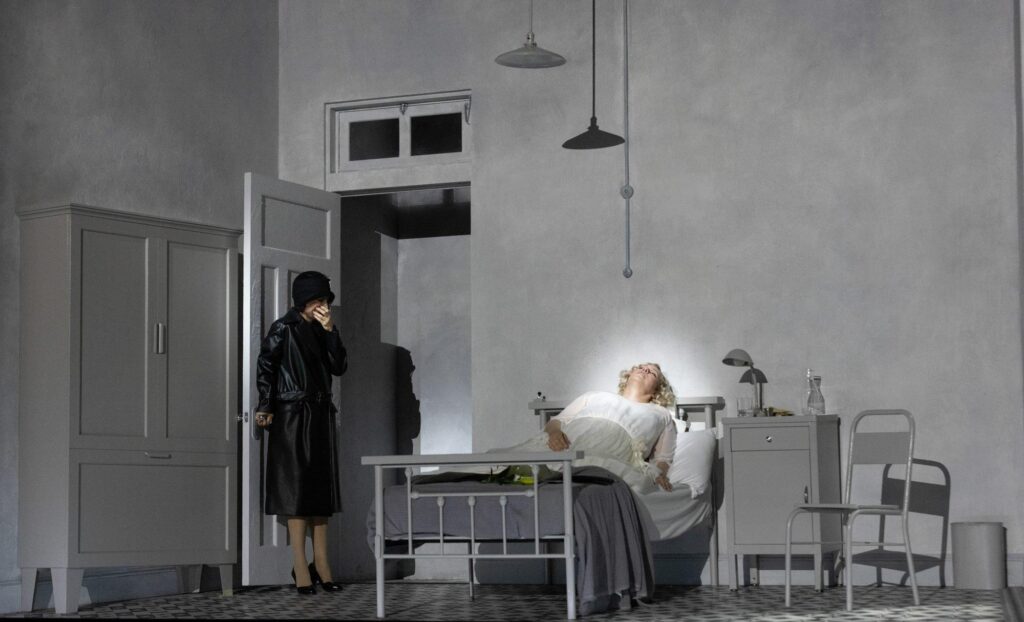
Image: Courtesy Santa Fe Opera
In the Zurich production Director Krystian Lada posed them singing separately, in the dying moments Lili turning away and exiting slowly backstage. Less emergency room pillow kitsch.
The characters of Claude LeJeune and Major Fernando Porta appeared en scene without the back story needed to explain their respective obsessive relationships with Lili and Gerda. Truly ‘out of the blue’.
Professor Warnekros was a missed opportunity. A chancer effectively exploiting the vulnerable Einar/Lili with promises based on unproven surgical techniques, in real life he went on to join Hitler’s Nazi Party – party number 2,453,061- and practice eugenics on non-consenting patients.
A long journey for the Prof, as the Nazis did not favour queer culture and non-conforming gender research. He needed to be a central character and his duping of the vulnerable Einar/Lili exposed.
The original Zurich production of Lili Elbe is here. The Danish Girl is here.
So, what is the Lucia Lucas story, and why was she cast in the role? I asked contacts I bumped into in the interval – intrigued – ‘Who’s her cover’? Essential for a lead role in any front-line show. There was no-one on the programme. Much shuffling of feet and awkward glances. After all, there are not many self-identifying female baritones on the circuit.
I now understand there was one, but he/she was very inexperienced. We were in a ‘no show without Lucia’ situation, hazardous to say the least.
Further digging revealed that in 2019 Lucia Lucas had performed in Tulsa Opera’s Don Giovanni – as Don Giovanni himself!! The conductor? Tobias Picker.
Was I falling down some woke rabbit hole? There is a documentary of the making of the Tulsa opera, The Sound of Identity, and if you don’t mind reducing your lifespan by 90 minutes it’s a much watch to understanding the Picker/Lucas relationship.
The passage where it is revealed that Lucia is obsessed with video games, mindlessly playing Super Mario with a disinterested, phlegmatic Picker, suspends belief in her credibility. And perhaps his for tolerating rubbish of this sort.
Lucia turns out not only to be a bad singer with no stage presence. She is unmasked as trivial. The Sound of Identity is produced by Shout Studios!, an Opera Music LGBTQ Documentary. ‘Nuff said! I rest my case.
Scenery was complex, but of the period, unlike the Zurich production. Better. But so complex that it was difficult to manage set changes without breaks. Picker was asked to infill with impromptu interludes. Good for him.
After all 18th century Mozart opera orchestras were often playing from ink-wet scores. Costumes were glorious, changing in colour and intensity to match the Einar/Lili transition.
Finally, the Orpheus/Euridice idée fix. Actress Anna had been playing the role at the Danish theatre, so Picker/Stollen milked it for all it was worth. A running metaphor of Einar/Lili never looking back. At last, a trick that worked. It held the plot of the opera together, until that final scene when it all unravelled with two heads on a pillow.
The Crosby Theater at Santa Fe is a wonder. In an impossible New Mexico hilltop location, isolated from the town five miles away. The auditorium open on the sides, and backstage if need be, to the elements and the setting sun. Framed by two mountain ranges, the Sangre Cristo Mountains to the east and Jemez mountains to the west there can be no opera house as spectacular – or challenged.
In my case by smoke and ash from The Frijoles Fire in the Santa Fe Mountains thirty miles away. The performance of Madame Butterfly was stopped short as ash affected the singers’ voices and cloaked the audience. Performances of Handel’s Rodelinda and Tchaikovsky’s Eugene Onegin also fell foul of tight air quality regulations. A long way to travel to see two shows out of five.
Lili besides, I saw a questionably comic version of Mozart’s The Magic Flute directed by Christopher Luscombe. More to follow.
But I shall return to Santa Fe next year. I am Scottish and have three refunded tickets to use!
Don’t be put off Santa Fe Opera by the dodgy Lili Elbe. Next season’s highlights are Mozart’s Cosi fan tutte, directed by Amy Lane, Janáček’s Katya Kábanová and Brett Dean’s Of One Blood, featuring Mary Stuart and Elizabeth Tudor.
I hope I have not been unfair to Lili Elbe. But, as the second Act started and I found myself entirely deserted in row V of the orchestra stalls, perhaps my judgement was shared by many in the audience who had run for the interval – and from Santa Fe.